Power Surge Electric LLC Journal
Storm Tore Up Your Weatherhead? Know Your Next Step
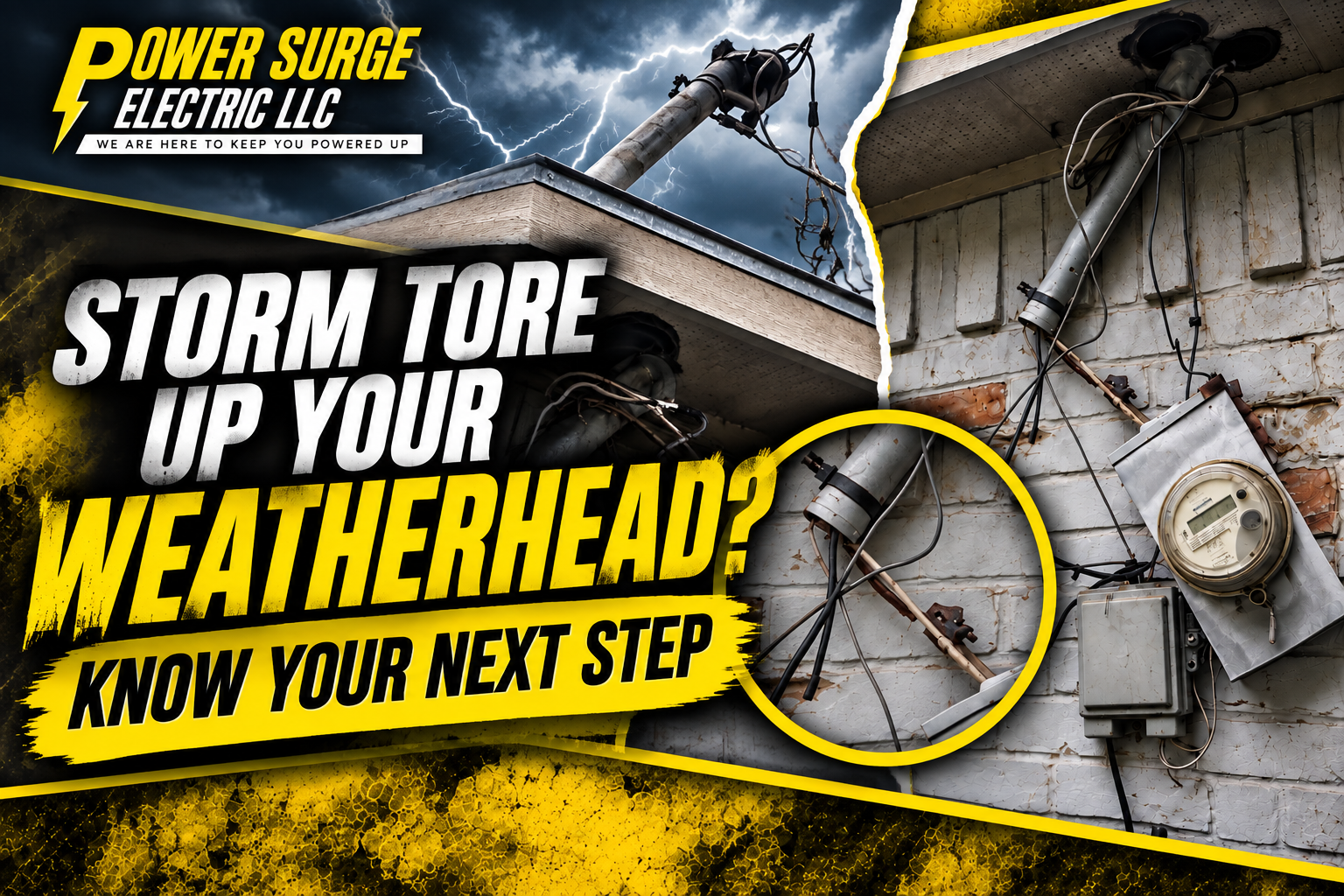
When a storm rolls through the Gulf Coast, the wind doesn’t just take down tree limbs and fence panels. One of the most common — and most misunderstood — kinds of storm damage we see at homes in La Porte, Deer Park, and Pasadena is damage to the weather head: the point where the power lines connect to your house.
If a hurricane or a strong line of thunderstorms leaves your weather head hanging, your mast bent, or your meter pulled halfway off the wall, the first question almost everyone asks is the right one: “Do I call the electric company, or do I call an electrician?”
The answer isn’t as simple as most people expect, so let’s clear it up.
What Is the Weather Head, Exactly?
The weather head — also called the service head, weather head, or service entrance — is the fitting at the top of your service mast where the utility’s overhead wires connect to your home’s wiring. You’ve seen it a hundred times: it’s usually a metal pipe running up the side of the house or through the roof, with a rounded cap at the top and the power lines drooping into it.
That little section is where two different worlds meet: the utility’s equipment and your home’s equipment. And that dividing line is exactly what decides who is responsible for repairs.
Where the Utility’s Responsibility Ends and Yours Begins
Here’s the part most homeowners don’t realize. The power company (in our area, that’s CenterPoint Energy) owns and maintains the service drop — the overhead wires running from the pole or transformer to the connection point at your house. If those wires come down in a storm, that’s on them.
But everything from that connection point into your home is your responsibility as the property owner. That includes:
The
weather head
itself
The
service mast or riser
(the pipe it sits on)
The
service entrance conductors
(the wires running down to your meter)
The
meter base
(the metal box the meter plugs into)
Your
main panel
and breakers inside
So when a storm tears the mast off your roof or rips the meter base loose from the wall, that damage is on the homeowner’s side of the line — which means it takes a licensed electrician, not the utility, to repair it.
A Common Storm Scenario
Here’s how it usually plays out. A gust catches a large limb, the limb takes the service drop wires with it, and the pulling force bends or rips your mast right off the roof. Now you’ve got two separate problems:
The downed wire from the pole is the utility’s to reconnect. The bent mast, cracked weather head, and pulled meter base are yours to repair. And here’s the catch: the utility usually won’t reconnect their wires until your side has been fixed, inspected, and cleared. If they reconnected to a damaged mast, they’d be energizing a hazard.
That’s why these repairs almost always happen in a specific order:
The utility
disconnects
power at the drop (or it’s already down).
A licensed electrician
repairs
the mast, weather head, meter base, and any damaged service entrance wiring, and pulls the required permit.
The city or county
inspects
the work.
The utility comes back out and
reconnects
power.
Trying to skip steps here doesn’t just risk a failed inspection — it risks a fire.
Warning Signs Your Weather Head or Mast Was Damaged
After a storm, walk the outside of your house and look up at where the power lines meet the roofline. Call a licensed electrician right away if you see:
A mast that’s
leaning, bent, or pulled loose
from the roof
A weather head that’s
cracked, twisted, or hanging
A
meter pulled partway out
of its base, or a meter box hanging off the wall
Frayed, exposed, or scorched
service wires
Burn marks, a burning smell, or buzzing/arcing
around the meter or panel
Half your house has power
and half doesn’t (a sign you may have lost one leg of your service)
A Word on Safety — Please Read This
Never, ever touch a downed power line or anything it’s touching — a fence, a puddle, a tree limb, standing water. Always assume a downed line is live, even if the power looks like it’s out. Keep your family and pets well clear, and if a line is down and sparking or a fire risk is present, call 911 and your utility immediately.
For mast and meter damage where there’s no immediate danger, call a licensed electrician. A good one will coordinate directly with the utility so you’re not stuck playing middleman during an already stressful week.
We’re Here to Help You Get Power Back Safely
Storm season on the Gulf Coast is exactly when this kind of damage happens, and we handle it every year. At Power Surge Electric, we’ll assess the damage, pull the permits, make the repair right, get it through inspection, and coordinate the reconnect with the utility — so you can stop worrying about your service and get your home back to normal.
If your weather head, mast, or meter took a hit in the last storm, give us a call. We serve La Porte, Deer Park, Pasadena, and the surrounding communities.
Power Surge Electric LLC — We are here to keep you powered up.
Call us: (281) 221-9395 | La Porte • Deer Park • Pasadena
Written by Tyler Beene with first-hand expertise. AI tools may be used for research and drafting assistance, but all content is reviewed, verified, and published by the author.