Power Surge Electric LLC Journal
Home EV Charger Installation: What Texas Homeowners Need to Know
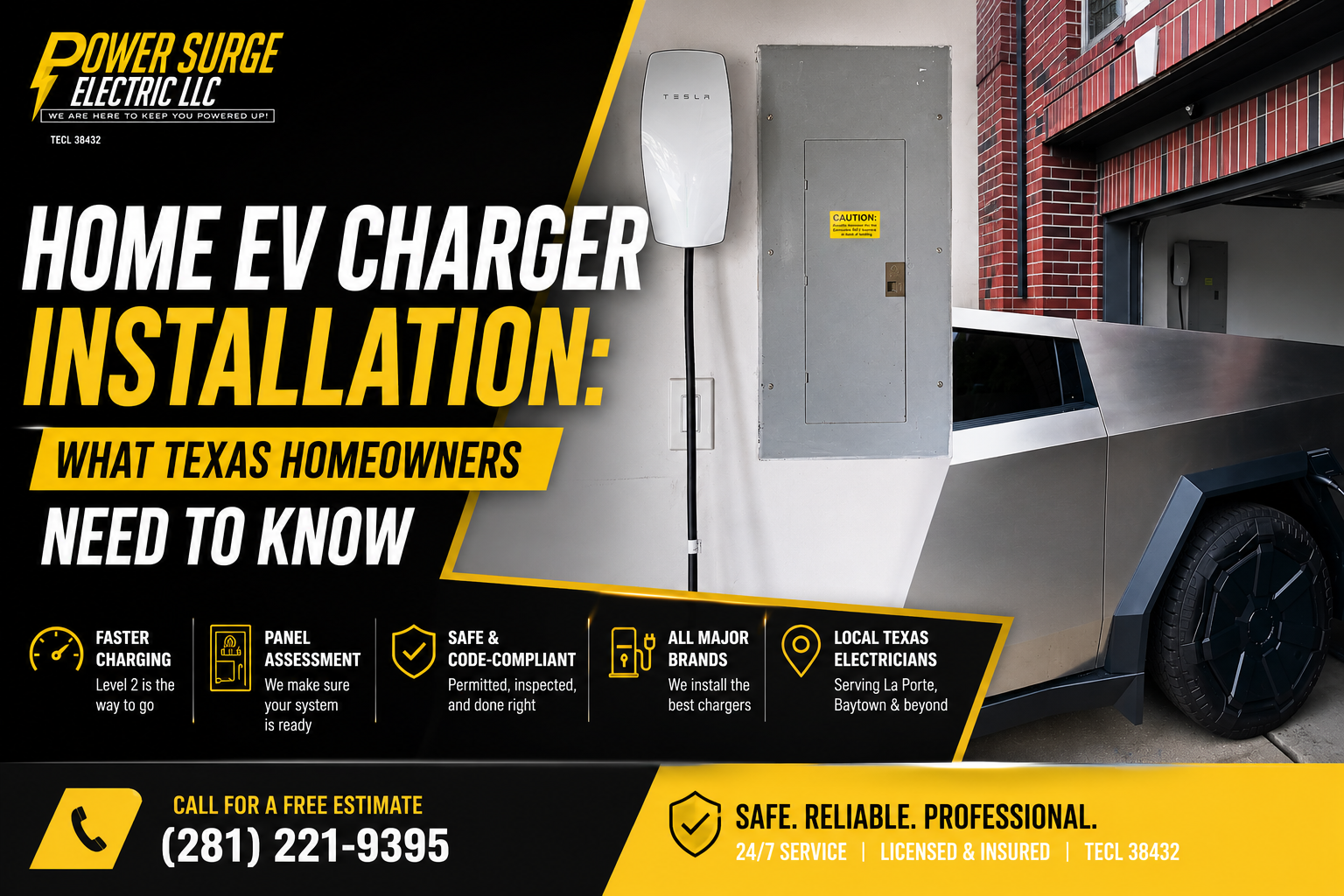
Bought an electric vehicle, or thinking about it? Charging at home is one of the biggest perks of going electric — you wake up every morning with a "full tank." But getting there safely means more than plugging into any outlet. Here's what you need to know about installing an EV charger at your Texas home.
Level 1 vs. Level 2 Charging
There are two ways to charge at home, and the difference comes down to speed:
Level 1 — the cord that came with your car, plugged into a standard 120V outlet. Simple, but slow: roughly 3–5 miles of range per hour. Fine for low-mileage drivers, frustrating for everyone else.
Level 2 — a dedicated 240V charger (the same kind of circuit your dryer or oven uses). Much faster: about 25–30 miles of range per hour, so most drivers wake up fully charged. This is what most homeowners want.
For most people, a Level 2 charger is the upgrade that makes home charging genuinely convenient.
Can Your Electrical Panel Handle It?
A Level 2 charger draws real power — typically a dedicated 240V circuit at 50–60 amps. Before installing, we assess your panel to make sure it has the capacity and space to add that load safely.
In many homes, no upgrade is needed. But if your panel is older, already full, or near capacity, you may need a panel upgrade first — especially if you're also running AC, an electric range, and other large loads. We only recommend that if it's genuinely necessary, and we'll tell you up front.
What a Proper EV Charger Install Involves
Panel assessment — confirming your electrical system can handle the added load
Dedicated 240V circuit — running a properly sized circuit to where you park
Charger mounting — installing the unit in a convenient spot, usually the garage or carport near your charge port
Safe wiring and connections — done to code and properly protected
Permit and inspection — pulled and coordinated for your city
Testing and labeling — making sure everything works and is clearly marked
A typical install runs 2–4 hours when no panel upgrade is needed.
What Chargers Do You Install?
We install all major EV charger brands, including:
Tesla Wall Connector
ChargePoint
JuiceBox
Grizzl-E
ClipperCreek
We can also install the charger that came with your vehicle — just let us know what you have.
How to Get Started
Getting a quote is easy. Send us three photos and we can scope most jobs before we ever set foot on site:
Your electrical panel (door open, breakers visible)
The spot where you park
The path between the two
From there we'll give you a straight estimate and get you scheduled.
Frequently Asked Questions
Do I need a special outlet for my EV? For fast Level 2 charging, yes — a dedicated 240V circuit. Level 1 uses a standard outlet but charges slowly. Most homeowners choose Level 2.
Will installing an EV charger overload my panel? Not if it's done right. We assess your panel's capacity first and only add the charger if it's safe, or recommend an upgrade if needed.
How long does installation take? Usually 2–4 hours when no panel upgrade is required. If an upgrade is needed, we may split it into two visits.
Can you install a Tesla Wall Connector? Yes — Tesla Wall Connector plus ChargePoint, JuiceBox, Grizzl-E, ClipperCreek, and more, including the unit that came with your car.
Ready to Charge at Home?
A properly installed Level 2 charger turns home charging from a chore into a convenience. If you'd like a safe, code-compliant setup done right the first time, reach out to Power Surge Electric.
Call (281) 221-9395 for a free over-the-phone estimate. Serving La Porte, Baytown, Deer Park, Pasadena, and surrounding Southeast Texas — 24/7.
Written by Tyler Beene with first-hand expertise. AI tools may be used for research and drafting assistance, but all content is reviewed, verified, and published by the author.